


November11 2026 (Wed)
7:00 PM
7:00 PM
The Tulip Fever
Drama with English subtitles
Estates Theatre - Prague Opera tickets
1 minutes | National Theatre drama with subtitles | Available

| Date: | November 11, 2026 | 19:00 (Wed) |
|---|---|
| Venue: | Estates Theatre - Prague Opera tickets |
| Duration: | 1 minutes |
| Intermission: | No |
| Status: | Available |
Ticket in your mobile device accepted
The hilarious, unsettling story of the world's first get-rich-quick scheme
In Czech, surtitles in English
The Tulip Fever is an adaptation of the classic comedy Spanish Brabander (Spaanschen Brabander, 1618) written by Shakespeare’s contemporary Gerbrand Breder (1585-1618), a master playwright of the Dutch Golden Age. The play describes the machinations with tulip bulbs – which in 1637 led to what is considered the first speculative bubble – set against the backdrop of the picaresque poetics of swindlers at the time. The text is skillfully interspersed with typical attributes of real capitalism: quick money, monetization of human relationships, profitable investments, madness of crowds, political scheming, and the notorious uppishness of public figures.
In fact, Jerolimo orchestrates this major investment campaign, targeted at the Amsterdam bourgeoisie, secretly amidst a never-ending party at Madame Beatrice’s brothel. Will the (mostly sober) people of Amsterdam see through his cynicism before it is too late? Will they come to their senses before realising that they served him not only as a joke, but also as a source of profit? And that it destroys people’s souls? Mhm?! Hardly.
In clear comedic exaggeration, the play elaborates on the theme of financial machinations, the desire to get rich quick, and, in fact, also the principles of crypto trading. Based on a concrete historical event, it shows that the desire for astronomical financial gains through a kind of “pyramid scheme” is far from new. Indeed, the term Tulip Fever (or Tulip Mania) refers to one of the earliest speculative bubbles, which affected the Netherlands in the first half of the 17th century. It started with cross-breeding of colour varieties of tulips, until then an overlooked flower native to Turkey, thanks to which the interest in the bulbs rocketed to unprecedented levels. Only as late as in the twentieth century, it was discovered that the spectacular intricate lines and flame-like streaks on the petals were actually due to the bulbs being infected with a virus...
Important:
- The purchased tickets cannot be returned or exchanged
- No discounts are provided
- Theatre is a cultural institution. Please respect the common principles of appropriate behaviour and clothing.
- The program may be subject to change
- The price includes a service fee of 3,7 € (100,- CZK)
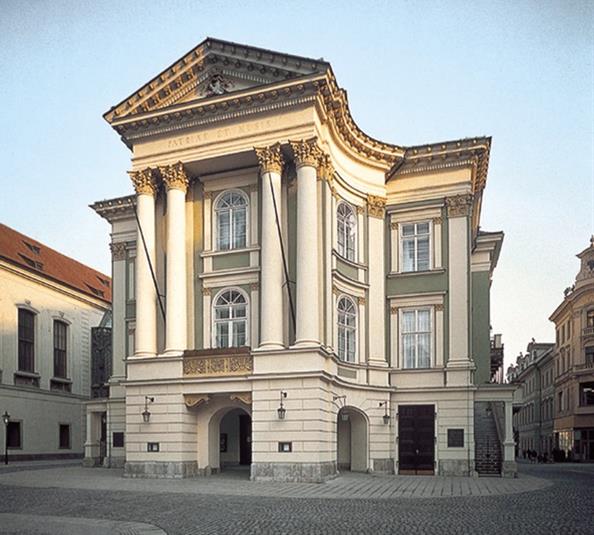 Venue photo gallery
Estates Theatre - Prague Opera tickets
| Address: | Ovocný trh 1 , Praha 1 |
|---|---|
| Capacity: | 589 |
| Type: | Theatre |
| Winter heating: | Yes |
| Wheelchair access: | Yes |
The Estates Theatre is one of the most beautiful historical theatre buildings in Europe
The Estates Theatre is deeply linked with the name of W. A. Mozart. Besides other of his works, it was the venue of world premieres of two Mozart operas: Don Giovanni (on 29 October 1787 – conducted by the composer himself) and La clemenza di Tito (1791, to mark the coronation of Leopold II). Enjoy the festive atmosphere of this beautiful theatre in which W. A. Mozart received enthusiastic ovations after conducting his operas. The Estates Theatre is in operation continuously since 1783. It was built by enlightened and patriotically minded Count Nostitz Rieneck, who thus aimed to enhance the cultural life of Prague inhabitans.
His idea, that a generally accessible theatre is a moral institution demonstrating the cultural level of the nation, was in compliance with the spirit of the late 18th century, the Age of Enlightenment, and the project of theatre was extremely important for Prague of that time. Although presenting plays in German language at first, the theatre soon started staging also Czech plays. In 1798 the Theatre was bought by the Czech Estates, hence its today´s name.
The Estates Theatre is inseparably linked with Wolfgang Amadeus Mozart. The composer has visited Prague couple of times to compose and give concerts here, and in 1787 he presented his opera The Marriage of Figaro in the Estates Theatre.
Under the impression of its enthusiastic reception Mozart composed the Don Giovanni opera for Prague, and personally conducted its world premiere in the Estates Theatre. The opera was an immense success and that is how Don Giovanni and the Estates Theatre have entered the history...
The Estates Theatre was one of the locations in the famous film Amadeus by Miloš Forman. Although the name of Mozart shines the most brightly in the history of the theatre, the Estates Theatre allured many other distinct artists of Europe-wide significance.
Carl Maria von Weber was a musical director of the Theatre; the violin virtuoso Niccolo Paganini gave a concert here; Arthur Rubinstein, Carl Goldmark and Gustav Mahler conducted at the theatre. Other famous personalities are i.e. the actors W. A. Iffland, F. Raimund, J. N. Nestroy, W. Scholze, I. Aldrige and many others.
The Estates Theatre was extremely important for the Czech theatre. From the pioneers such as the Thám brothers, to V. K. Klicpera, J. K. Tyl, J. J. Kollár, etc., the generations of leading creators and artists presented their plays here. The first Czech modern opera, Škroup’s The Tinker, was presented here in 1826.
The play Fidlovačka by J. K. Tyl and F. Škroup, premiered here, includes the song “Kde domov můj” (Where is My Home), which would later become the Czech national anthem. In the Estates Theatre you can see opera, drama and ballet performances.
How to get there:
- Accessibility by public transport:
metro A ( green line) or B (yellow line) - Můstek station - Nearest car parking:
Millenium Plaza, V Celnici 10, Prague 1, or Palladium or Kotva shopping malls on Náměstí Republiky