


Prague's most attractive concert venues
Prague is one of Europe's great music cities, and its concert venues are a large part of why. Whether you're planning your first visit or returning, we'd love to help you find the perfect venue. Browse all upcoming events or get in touch with our team. Below you will see a selection of eleven most beautiful and atmospheric venues Prague has to offer. Prague concert venues aren't just places to hear music, they're part of the city's story:
Prague's concert halls and historic spaces offer an unmatched range of musical experiences, from the intimacy of the Klementinum Mirror Chapel to the grand splendour of the Rudolfinum - Dvořák Hall and the Art Nouveau magnificence of Municipal House - Smetana Hall. Sacred architecture lends its voice to the program too: the atmospheric Spanish Synagogue, the baroque gem St. Nicholas Church - Lesser Town , and the soaring St. James Basilica each transform every performance into something genuinely unique.
Opera and theatre lovers will find their home at the Prague State Opera and the legendary Estates Theatre, where Mozart himself once stood before the audience. For those drawn to jazz, blues, or world music, Jazz Dock on the Vltava riverbank and the legendary Reduta Jazz Club set the perfect scene for an unforgettable evening. And for something truly singular, Laterna magika - The New Stage continues to astonish with its unique blend of theatre, dance, and visual art. To help you find the best event venue in Prague, check the overview of Prague concert venues and sights.
Klementinum Mirror Chapel
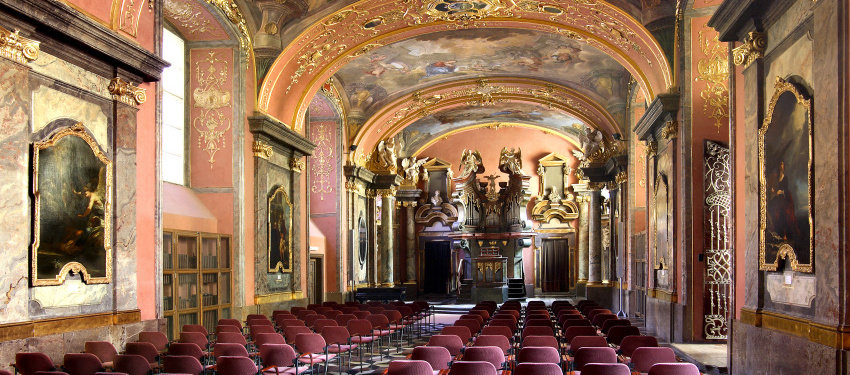
The Klementinum Mirror Chapel, originally dedicated to the Annunciation of the Virgin Mary, is a unique sanctuary and one of the churches of the former Jesuit college, Prague Klementinum. Construction of the Chapel dates to 1722-1726. The current name "Mirror" was created later, the reason was the use of many mirrors in the decoration of the walls and vaults.
Interesting facts about Klementinum Mirror Chapel:
- Part of Klementinum, one of the largest historic complexes in Europe, also home to a stunning Baroque library, Meridian Hall, and Astronomical Tower.
- Klementinum is also the main seat of the National Library, founded in 1781.
- The original organ, still placed on the music bar (choir), was built around 1732.
- The second organ, imported here in the second half of the 20th century, was additionally installed in the opposite part of the chapel, on the site of the former main altar.
- The chapel had been repeatedly desecrated and consecrated. It became a Prague classical concert and exhibition hall in 1936.
- Mozart himself is said to have been so captivated by the chapel's organ that he couldn't resist sitting down to play it.
- Klementinum Mirror Chapel tickets
Municipal House - Smetana Hall
(1).jpg)
Smetana Hall is a concert hall with a capacity of 1,200 seats, which has hosted some of the most outstanding international music ensembles and performers since its opening. In addition to concerts, it also hosts various events, such as traditional balls or galas. The name of the concert hall is a tribute to the famous Czech composer, Bedřich Smetana.
Learn about Municipal House:
- The Powder Gate next to the building was an important trade route, and the site where the Municipal House now stands served as the residence of King Wenceslas IV. in the 14th century. It was named the King's Court.
- The building was left unoccupied for a long period of time.
- The current Art Nouveau building was built from 1905 to 1911. The café, the French and the Pilsner restaurants, the American bar, the Lord Mayor’s Salon, and the Smetana Hall are all examples of Art Nouveau interiors, decorated by phenomenal artists and sculptors such as Alfons Mucha, Jan Preisler, Ladislav Šaloun, and others.
Find out more about Smetana Hall:
- The hall serves as a venue for the Prague Spring International Music Festival’s opening and closing concerts.
- The Smetana Hall is the home stage of the Prague Symphony Orchestra.
- Ladislav Šaloun’s stucco statues, called Vyšehrad and Slavonic Dances, placed along the sides of the stage, particularly stand out.
- Smetana’s Vyšehrad from the cycle of symphonic poems My Country is represented by the mythical figure of Lumír, narrating the legend of the homeland to harp accompaniment, while the dancing couple located on the opposite side is a motif from Dvořák’s Slavonic Dances.
- Smetana Hall’s interior features also other Czech composers whose portrait medallions decorate the box parapets and the parapet of the main balcony.
- Look up at the ceiling: Karel Špillar's monumental murals, Music, Poetry, Dance, and Drama, are considered among his finest works.
- Municipal House - Smetana Hall - tickets
Rudolfinum - Dvořák Hall
.jpg)
The Neo-Renaissance building Rudolfinum is situated near the Old Town Square, right on the bank of the river Vltava. Since its opening in 1885, it has been associated with music and art. Rudolfinum is the seat of the Czech Philharmonic. The Dvořák Hall is famous for its excellent acoustics and a smaller hall - the Suk Hall is great for chamber concerts and piano recitals. The name of the concert hall is a tribute to the famous Czech composer, Antonín Dvořák.
Rudolfinum - did you know?
- The building was built by Česká spořitelna (Czech Savings Bank) as a cultural centre designed for exhibitions and concerts, thus connecting music and art. This is still valid.
- Did you know that you can find several beehives on the roof of the Rudolfinum?
- In 1896, the Czech Philharmonic performed in Rudolfinum for the first time, and this special occasion was even more special since the most famous Czech composer Antonín Dvořák conducted the orchestra.
- The architectural design for Prague’s Rudolfinum was created by famous architects Josef Zítek and Josef Schulz, who had won a public tender. The building was constructed between 1876 and 1884.
- The Czech Philharmonic Orchestra, which includes the Czech Chamber Music Society, has been based in Rudolfinum since 1946.
- The first visitors came to the Rudolfinum Gallery in 1994.
- Since the 1990s, the stylish Cafe Rudolfinum has been in operation.
- Rudolfinum - Dvořák Hall - tickets
Spanish Synagogue
.jpg)
The Spanish Synagogue was built in 1868 for the local Reform congregation on the site of the 12th-century Altschul, which was the oldest synagogue in the Prague ghetto. The synagogue now belongs to the Prague Jewish Museum, it houses part of the exhibition, and popular concerts of classical and sacred music often take place here.
Explore more about the Spanish Synagogue:
- The synagogue is called the Spanish Synagogue for its impressive Moorish interior design, influenced by the famous Alhambra. The building was designed by Josef Niklas and Jan Bělský, the remarkable interior (from 1882–83) by Antonín Baum and Bedřich Münzberger.
- František Škroup, the composer of the Czech national anthem, served as organist here in 1836-45.
- The synagogue ceased to be used for divine services in 1941.
- Under Nazi and Communist regimes, the Spanish Synagogue was neglected and fell into a desolate state, and was eventually closed.
- The synagogue underwent several reconstructions since then.
- Widely regarded as one of the most beautiful synagogues in Europe (we think so, too!)
- Spanish Synagogue tickets
St. Nicholas Church - Lesser Town
.jpg)
The most famous Baroque masterpiece in Prague, the Church of St Nicholas, can be found on the Lesser Town square next to the former Jesuit college. With the neighbouring belfry, St Nicholas is the most distinctive and prominent landmark in the Lesser Town, completing the unique panorama of Prague.
Interesting facts about St. Nicholas Church:
- The church was built between 1704 and 1755 on the site of a Gothic church from the 13th century, which was also dedicated to Saint Nicholas.
- The diameter of the dome is an impressive 20 m; the height inside the church to the top of the lantern is almost 57 m, making it the tallest interior in Prague.
- Inside the St. Nicholas Church, you'll find numerous artworks, from the frescos on the ceiling and dome to the sculptures that adorn the walls.
- The church was built according to the plan of Kryštof Dientzenhofer, and three generations of his family (father, son, and son-in-law) worked on the church during the following century.
- The church’s decorations are purely Baroque and Karel Škréta's pictures are the most significant decoration.
- St. Nicholas Church tickets
- Visit the St. Nicholas Church Bell Tower.
St. James Basilica
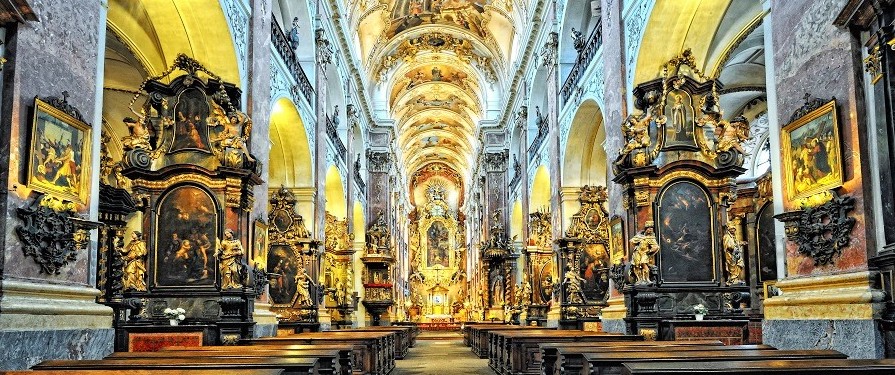
Since the 13th century, the St. James Basilica, belonging to the Franciscan order, has been an important spiritual center of Prague. It has also been a stop on a pilgrimage to Santiago de Compostela.
Why should you visit the St. James Basilica?
- The impressive interior of the St. James Basilica is a treasury of Baroque art.
- There's a mummified forearm hanging from the ceiling outside the church. The legends say it belonged to the thief who wanted to steal the Virgin Mary statue from the main altar. When he tried to reach her, she caught him by the arm and wouldn't let go until the prosecutor cut it off.
- The organ at the church is actually the second-largest organ in the Czech Republic. The origin of the organ goes back to the 18th century. After a major fire in 1689, a new organ was built by Abraham Stark of Loket, who had by then already produced several organs for various localities in Bohemia. The new two-manual organ was completed in 1705. The organ´s case, which is still admired today, was also unique for its time.
- The basilica is now renowned for its magnificent organ concerts and festivals.
- St. James Basilica tickets
- Check here for more information about the organ.
Prague State Opera
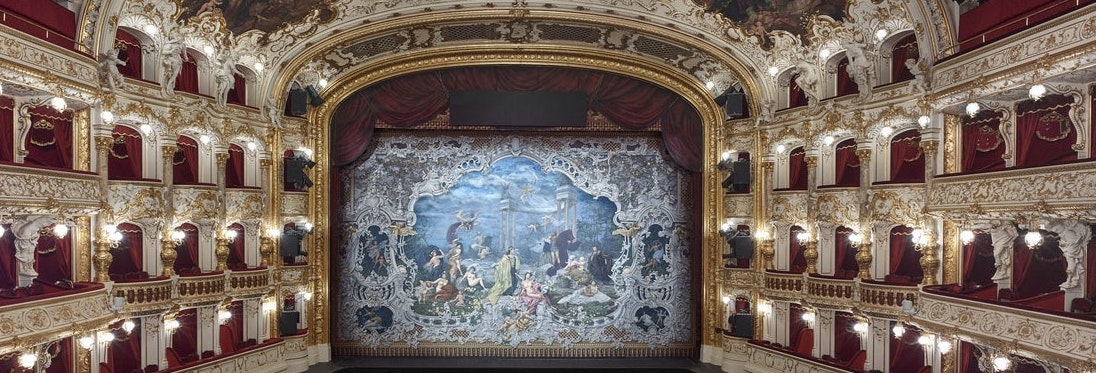
A prime opera house located in a magical neo-Renaissance building with an exquisitely decorated interior was refurbished in 2020. Famous ballets and operas, as well as pieces forgotten or unknown in the Czech Republic, are introduced in the State Opera, gaining the theatre a reputation as one of the best European scenes.
Interesting facts about State Opera:
- This Neo-classical edifice was built in 1888 by the German Theatre Association as a reaction of the German minority in Prague to the opening of the Prague National Theatre.
- The theatre was originally called the New German Theatre, and from 1949 to 1989 it was known as the Smetana Theatre.
- The first performance of the opera house on January 5th, 1888, was Richard Wagner's opera Die Meistersinger von Nürnberg.
- The State Opera is part of the National Theatre.
- Prague State Opera tickets
Estates Theatre
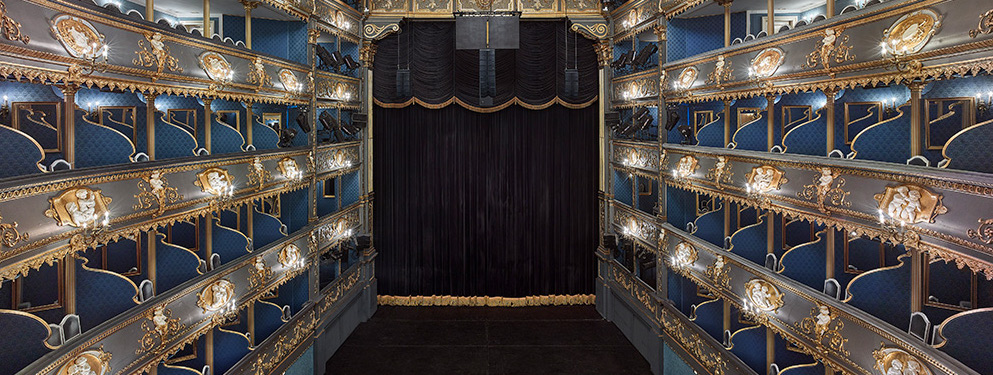
The Estates Theatre is one of the most beautiful historical theatre buildings in Europe, opened in 1783. The opera house is globally renowned for its special connection with the famous composer W. A. Mozart. The theatre offers opera and ballet performances as well as Czech and international drama.
Learn more about Estates Theatre:
- W. A. Mozart composed the Don Giovanni opera for Prague, and personally conducted its world premiere in the Estates Theatre. It is the only theatre left standing where Mozart performed.
- The Estates Theatre was one of the locations in the famous film Amadeus by Miloš Forman.
- The play Fidlovačka by J. K. Tyl and F. Škroup premiered in the Estates Opera and includes the song “Kde domov můj” (Where is My Home), which would later become the Czech national anthem.
- German was the language at the Estates Theatre until 1920, when it was taken over by the Czechs and affiliated with the National Theatre.
- Estates Theatre tickets
Jazz Dock
.jpg)
Jazz Dock, situated on the Vltava river banks, opened in 2009 and has become one of the important European jazz clubs featuring jazz, blues, world music, soul, etc. The interior of the jazz club is modern and cozy - great for both chamber performances as well as big productions. Its lovely atmosphere, variable program, and great location are what constantly draw us back in.
Why should you visit Jazz Dock?
- Jazz Dock´s ten-meter-long futuristic bar offers traditional drinks and cocktails, and also specialities.
- You can enjoy delicacies from the Jazz Dock kitchen and treat yourself to a tasty dinner, all the time during musical production.
- Jazz Dock has its own music concept. Its dramaturgy is specific to its several-day concert blocks of significant Czech jazz bands and foreign bands, and regular jazz festivals focused on a particular jazz genre, a specific country, or a dominant jazz instrument.
- Jazz Dock tickets
Reduta Jazz Club
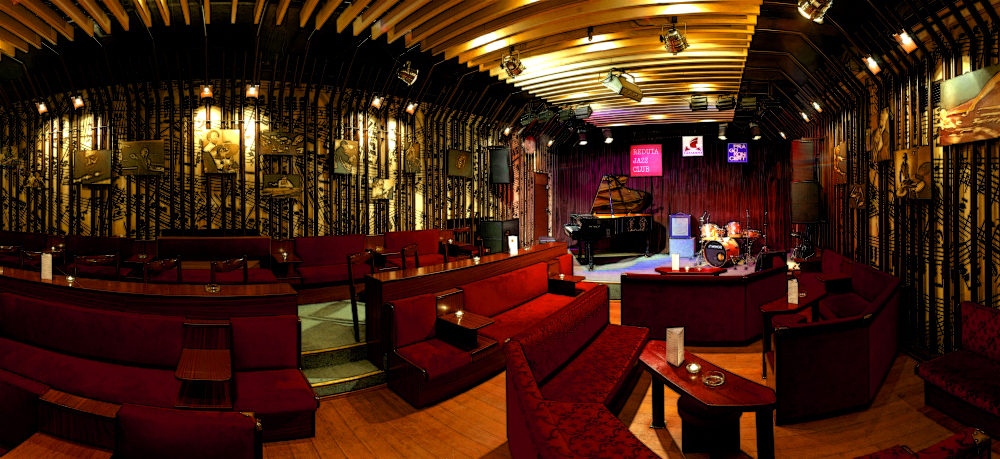
Founded in 1957, Reduta Jazz Club is the oldest continuously operated jazz and theatre club in the world. Not just a venue where you can have a great musical experience. Reduta is a term and a part of history, a cultural monument mentioned in professional publications and shown in movies. The club is located near the National Theatre, Old Town Square, and Wenceslas Square.
Don't miss the Reduta Jazz Club!
- You can enjoy a drink in the traditional Saxophone Bar, which offers a variety of drinks, including beer tapped into a golden saxophone.
- When the club was opened, the artists of Czechoslovakia were oppressed by the communist regime, and times were really hard. Reduta was one of the first experimental theatres, starting a revolution in European acting methods. And after performances, dissidents and crusaders for a free country were meeting in the club, discussing and planning until dawn. The regime took strong actions against them, but Reduta and its faithful continued until the fall of the communist dictatorship, and 30 years after the Velvet Revolution, the jazz club is still going strong.
- In 1994, the U.S. President Bill Clinton met with the Czech president Václav Havel, and many more significant politicians and businessmen in Reduta.
- Reduta Jazz Club tickets
Laterna magika - The New Stage
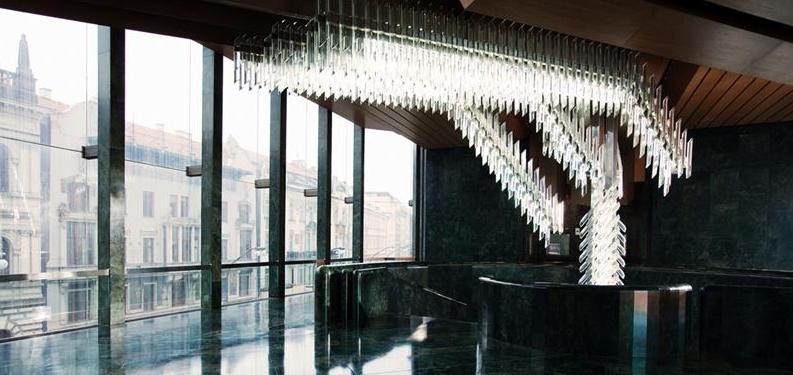
Most likely the world's first multimedia theatre, Laterna magika was founded as a cultural program at the 1958 Brussels Expo. It launched its official activity in 1959, as an independent company of the National Theatre, performing at the Adria Palace in Prague.
Interesting facts about Laterna magika:
- The building of the New Stage of the National Theatre was tailored to the specific requirements of Laterna magika performances. The unconventional edifice, covered by over four thousand pieces of glass tiles, was designed by Karel Prager.
- Wonderful Circus, which premiered in 1977, is the most frequently performed theatre piece in Central Europe, and has remained in the repertoire ever since.
- The fantastic world of the Laterna magika is full of pantomime, dance, music, film, and black light theatre.
- Laterna magika - The New Stage - tickets
Good to Know:
Which Prague concert venues are best for classical music? Prague's finest classical music venues include the Rudolfinum's Dvořák Hall, home of the Czech Philharmonic; the Municipal House's Smetana Hall, home of the Prague Symphony Orchestra; the Klementinum Mirror Chapel, with its original 18th-century organ; and the Spanish Synagogue, renowned for its extraordinary Moorish interior. Each offers a distinct atmosphere alongside world-class acoustics.
Where did Mozart perform in Prague? Mozart is connected to two venues still active today. The Estates Theatre hosted the world premiere of Don Giovanni, which Mozart personally conducted in 1787. The Klementinum Mirror Chapel also captivated Mozart, who is said to have performed on its historic organ during his visits to Prague.
What is the most beautiful concert hall in Prague? The Smetana Hall in the Municipal House is a stunning Art Nouveau masterpiece decorated by Alfons Mucha and other leading artists of the era. The Spanish Synagogue dazzles with its Moorish-inspired interior. The Estates Theatre, opened in 1783, is considered one of the most beautiful historic theatre buildings in Europe.
Which jazz clubs in Prague are the best? Prague has an excellent jazz scene. Jazz Dock, on the Vltava riverbank, is one of Europe's most respected jazz clubs, combining a modern interior with a varied international program full of jazz, blues and world music. Reduta Jazz Club, founded in 1957, holds the distinction of being the oldest continuously operated jazz club in the world and famously hosted Bill Clinton and Václav Havel in 1994.
Which Prague venue has the largest organ? The largest in Prague and the second largest organ in the Czech Republic is housed in St. James Basilica in the Old Town. Its origins date to the 18th century; the current instrument was completed in 1705 by Abraham Stark of Loket following a major fire in 1689. The basilica regularly hosts organ concerts and festivals.
Is the Prague State Opera worth visiting? The Prague State Opera is one of Central Europe's leading opera houses, and you can admire a beautifully restored neo-Renaissance building. Refurbished in 2020, it presents acclaimed productions of opera and ballet, including lesser-known works rarely staged elsewhere in Europe, and is considered one of the continent's finest opera venues.
When is the best time to visit a classical music concert? Prague's concert season runs year-round. In summer, Prague hosts several international organ festivals. In autumn, the Czech Philharmonic and Prague Symphony Orchestra open their new seasons at the Rudolfinum and Municipal House, respectively, while during winter, you can savour the Advent and Christmas music. And the spring calls for Easter and Easter music.
